
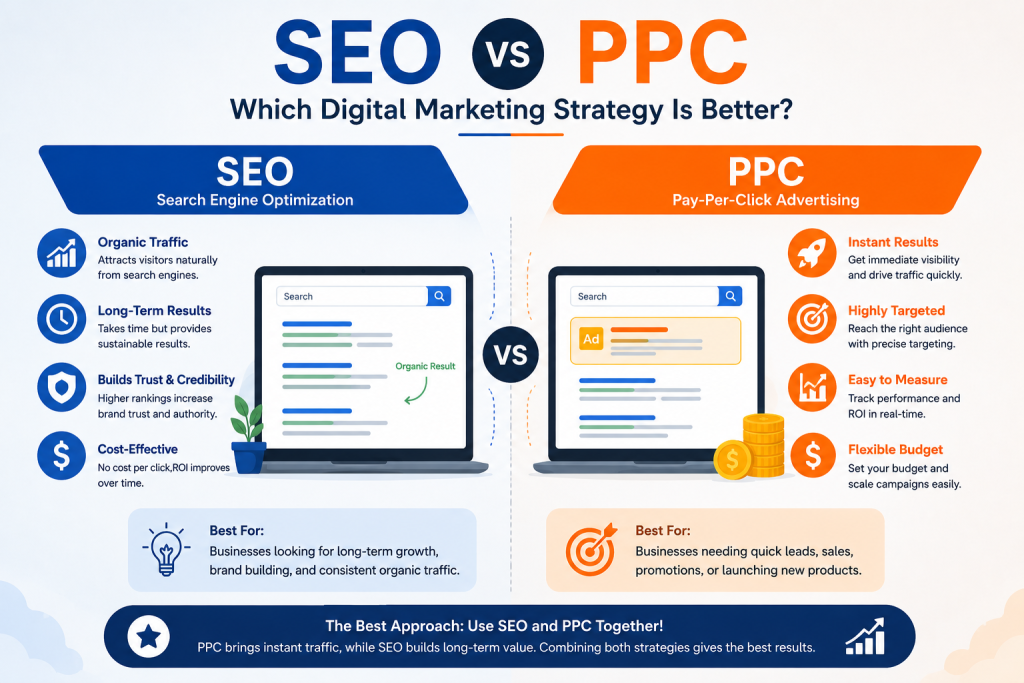
Every business wants one thing from its website—more visitors, more leads, and more sales. But simply creating a website is not enough. Millions of websites compete for attention every day, so businesses need effective ways to reach their target audience. This is where digital marketing becomes important.
Among the many digital marketing strategies available today, SEO (Search Engine Optimization) and PPC (Pay-Per-Click Advertising) are two of the most popular. Both help businesses attract potential customers through search engines like Google, but they work in completely different ways. SEO focuses on improving a website’s visibility in organic search results, while PPC allows businesses to pay for advertisements that appear at the top of search engine results pages.
Many beginners often ask the same question: Which strategy is better—SEO or PPC? The answer is not as simple as choosing one over the other. It depends on a business’s goals, budget, timeline, and marketing objectives. In this blog, we will compare SEO and PPC in detail to understand their advantages, disadvantages, and the situations where each strategy works best.
What is SEO?
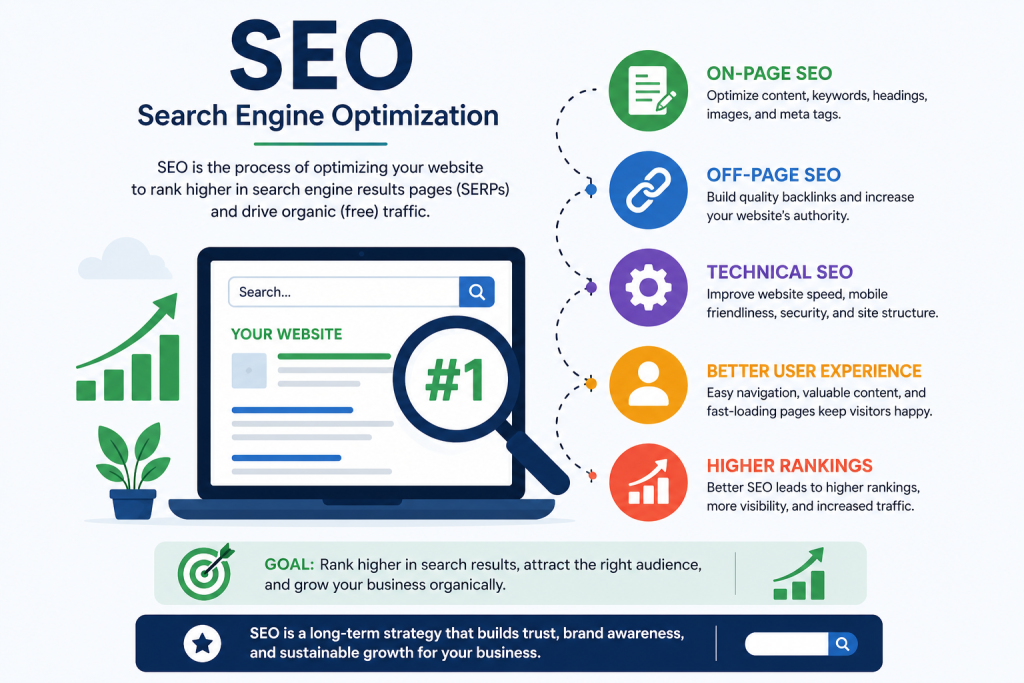
SEO stands for Search Engine Optimization. It is the process of improving a website so that it ranks higher in the organic (unpaid) search results of search engines like Google, Bing, or Yahoo. The main purpose of SEO is to increase website traffic without paying for every visitor.
SEO works by helping search engines understand your website better. When someone searches for information, products, or services, Google tries to show the most relevant and useful pages. If your website provides valuable content and follows SEO best practices, it has a better chance of appearing on the first page of search results.
SEO has three major parts:
On-Page SEO: This includes optimizing page titles, headings, keywords, images, URLs, and creating high-quality content that answers users’ questions.
Off-Page SEO: This focuses on building the website’s authority through backlinks, social media mentions, and online reputation.
Technical SEO: It ensures that the website loads quickly, works well on mobile devices, has a secure connection (HTTPS), and can be easily crawled by search engines.
Although SEO takes time to produce results, it builds a strong online presence that can continue generating traffic for months or even years.
What is PPC?
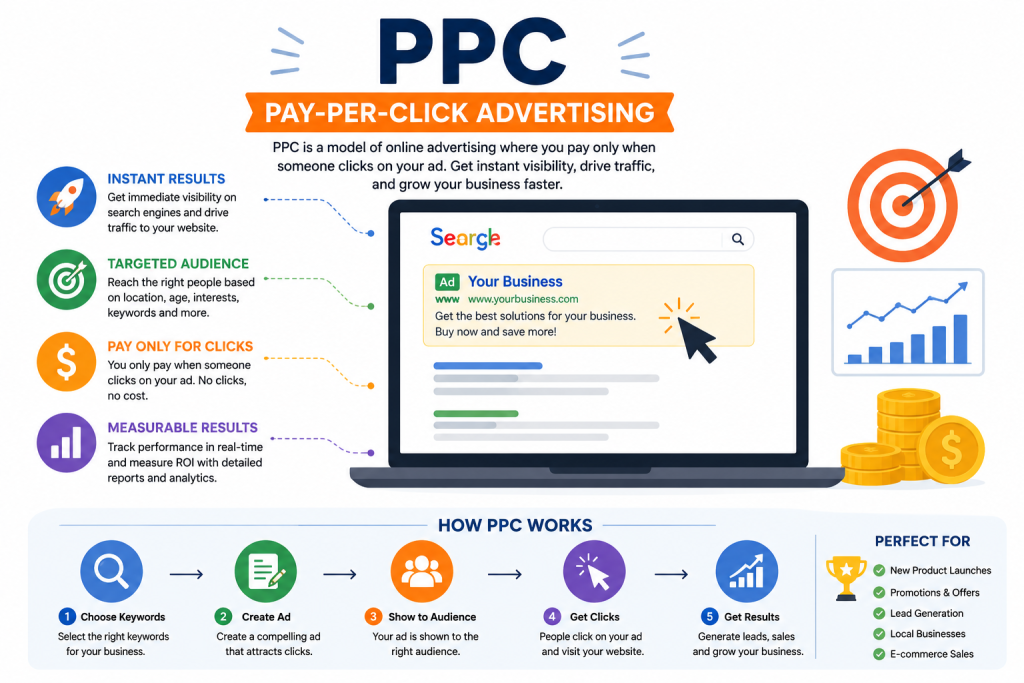
PPC stands for Pay-Per-Click advertising. As the name suggests, advertisers pay a certain amount every time someone clicks on their advertisement. The most popular PPC platform is Google Ads, but businesses also use Microsoft Ads, Facebook Ads, Instagram Ads, and LinkedIn Ads.
When a business runs a PPC campaign, its advertisement appears above the organic search results for selected keywords. For example, if someone searches for “best running shoes,” paid advertisements often appear before the regular search results.
Unlike SEO, PPC can generate traffic almost immediately after the campaign goes live. Businesses can also choose their target audience based on location, age, interests, devices, and even the time of day.
However, PPC works only while the advertising budget is active. Once the campaign stops, the traffic usually stops as well.
SEO vs PPC: Key Differences
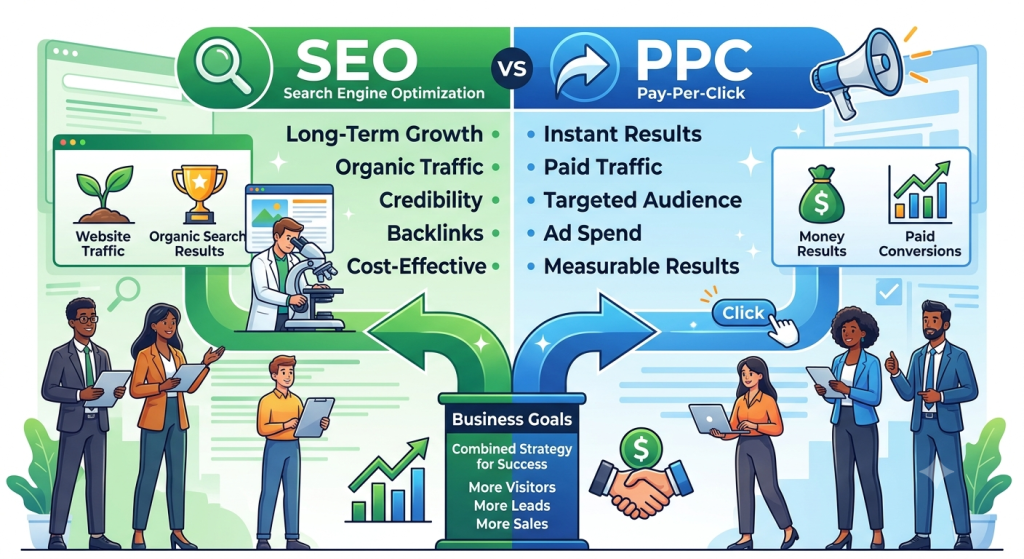
Although both SEO and PPC help attract visitors, they differ in several important ways.
The biggest difference is cost. SEO does not require payment for every website visitor. Instead, businesses invest time, effort, and resources into creating quality content and improving their website. PPC, on the other hand, requires advertisers to pay for each click their ads receive.
Another major difference is the speed of results. PPC delivers immediate visibility because advertisements appear as soon as the campaign is approved. SEO is a long-term strategy that may take several weeks or months before significant improvements become visible.
In terms of trust, many users prefer clicking on organic search results because they believe these websites are more reliable than paid advertisements. Organic rankings are often seen as a sign of quality and authority.
However, PPC provides much greater control. Businesses can easily adjust their advertising budget, pause campaigns, test different advertisements, and target specific audiences.
SEO requires continuous optimization because search engine algorithms frequently change. Similarly, PPC campaigns also require regular monitoring to improve ad quality, reduce costs, and increase conversions.
Advantages of SEO
One of the biggest advantages of SEO is long-term growth. Once a website starts ranking well, it can continue attracting visitors without paying for every click.
SEO also helps build credibility. People generally trust websites that appear naturally in search results. High organic rankings often improve a brand’s reputation and customer confidence.
Another benefit is cost-effectiveness. Although SEO requires investment in content creation and optimization, it usually becomes more affordable over time compared to continuously paying for advertisements.
SEO also improves the overall user experience. Faster websites, mobile-friendly designs, useful content, and easy navigation not only help search rankings but also keep visitors engaged.
Disadvantages of SEO
The biggest disadvantage of SEO is that it requires patience. Businesses rarely achieve first-page rankings overnight. It often takes several months of consistent effort.
SEO is also highly competitive. Popular industries have thousands of websites competing for the same keywords, making it difficult for new websites to rank quickly.
Another challenge is that search engine algorithms constantly change. Businesses must regularly update their SEO strategies to maintain good rankings.
Advantages of PPC
PPC offers instant visibility. Businesses can start receiving website traffic within hours after launching a campaign.
It also provides accurate audience targeting. Advertisers can select exactly who should see their advertisements based on demographics, interests, location, and search behavior.
Another advantage is measurable performance. PPC platforms provide detailed reports showing clicks, impressions, conversions, costs, and return on investment. This allows businesses to improve their campaigns continuously.
PPC is also ideal for promoting limited-time offers, seasonal sales, product launches, or special events where immediate results are necessary.
Disadvantages of PPC
The biggest disadvantage of PPC is cost. Every click requires payment, and competitive keywords can become very expensive.
Another limitation is that traffic stops when the advertising budget ends. Unlike SEO, PPC does not continue bringing visitors after campaigns are paused.
PPC campaigns also require careful management. Poor keyword selection, weak advertisements, or incorrect audience targeting can quickly waste the advertising budget.
When Should You Choose SEO?
SEO is the better choice when a business wants long-term growth, consistent website traffic, and strong online authority.
It works well for blogs, educational websites, service-based businesses, local businesses, and companies planning to grow steadily over several years.
Businesses with limited advertising budgets often benefit from investing in SEO because the long-term return can be significant.
When Should You Choose PPC?
PPC is suitable when businesses need immediate results.
It is an excellent option for launching new products, promoting discounts, generating leads quickly, or entering highly competitive markets.
E-commerce websites often use PPC during festive seasons or major shopping events to increase sales within a short period.
Can SEO and PPC Work Together?
Many people think businesses must choose either SEO or PPC, but that is not true. In fact, the most successful companies combine both strategies.
PPC provides immediate traffic while SEO gradually builds long-term organic visibility. Businesses can also use PPC data to identify high-performing keywords and then create SEO content around those keywords.
For example, a new online clothing store can use Google Ads to attract customers immediately while working on SEO to improve its organic rankings over time. As SEO becomes stronger, the business may reduce its advertising costs without losing website traffic.
Using both strategies together creates a balanced digital marketing approach that delivers both short-term and long-term benefits.
Conclusion
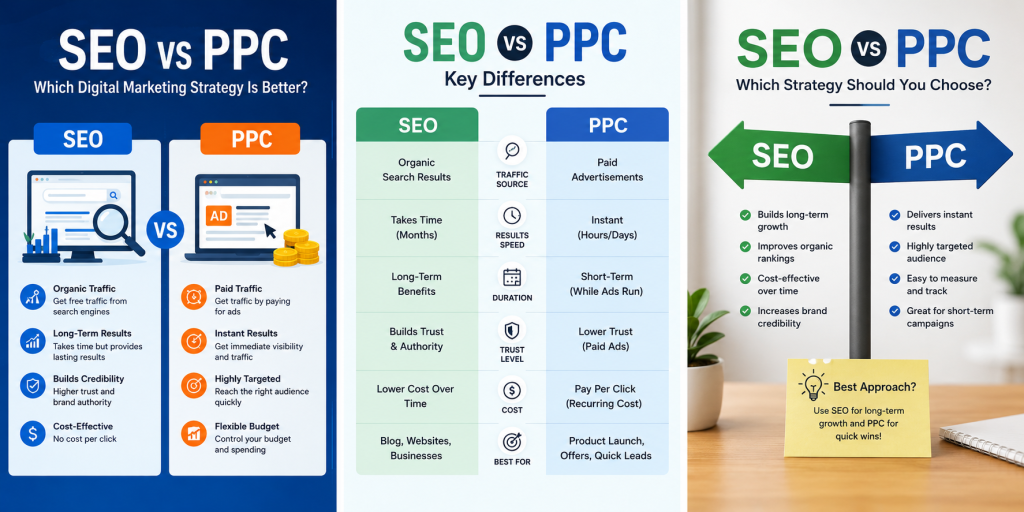
There is no single answer to the question, “SEO or PPC—which is better?” Both strategies have unique strengths and limitations.
If your goal is long-term growth, higher credibility, and sustainable traffic, SEO is the better investment. If you need immediate visibility, faster leads, or want to promote a special campaign, PPC is the right choice.
Instead of treating SEO and PPC as competitors, businesses should see them as complementary strategies. A well-planned combination of both can increase brand awareness, attract the right audience, improve conversions, and support long-term business growth.
In today’s competitive digital world, the smartest marketing strategy is not choosing one over the other—it is knowing when and how to use both effectively.